
MENU
MENU
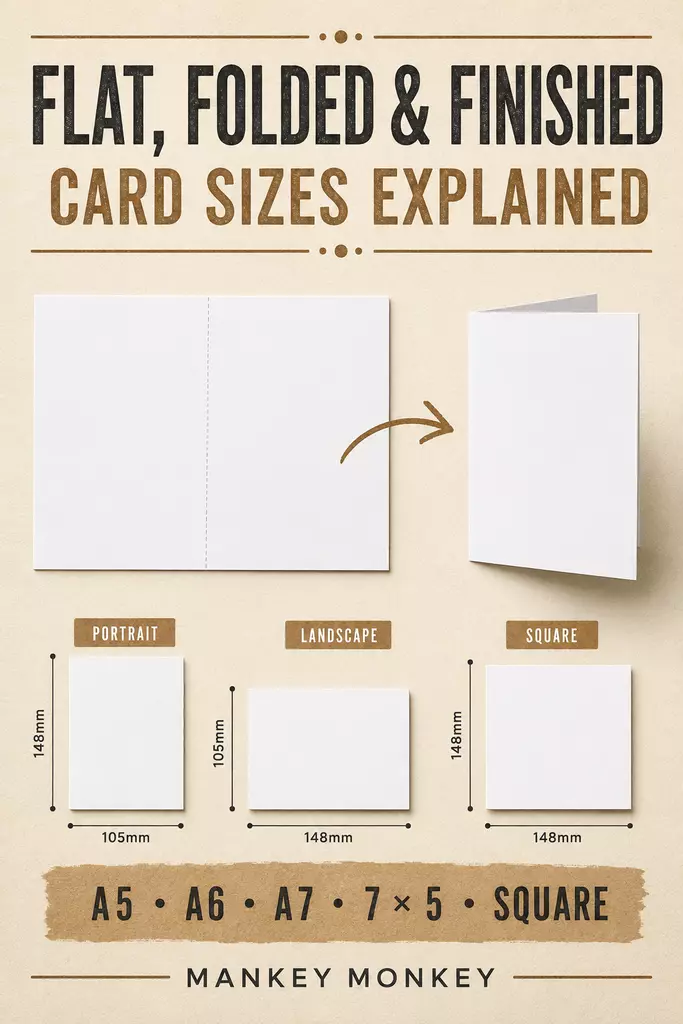
An A4 card blank does not produce an A4 greeting card. A 7" × 5" card is not supplied as a flat sheet measuring 7" × 5". And a 148mm square card starts life looking decidedly rectangular.
The important distinction is whether a measurement describes the card open and flat or folded to its finished size.
This guide explains the difference, covers several of the most popular card sizes and helps you choose the right blank for your project.
The flat size is the full measurement of the card before it is folded.
The folded size, sometimes called the finished size, is the measurement of the card after it has been folded along the crease.
For a simple card with one central fold, one dimension is effectively divided in half. For example, a flat A4 sheet measuring 210mm × 297mm produces an A5 card measuring approximately 148mm × 210mm when folded.
This distinction matters when choosing card blanks, envelopes and printer settings. Ordering a card based on its flat dimensions when you actually need a particular finished size can leave you with something twice as large—or half as large—as expected.
If you need a broader comparison of standard sheet measurements, our complete guide to cardstock sizes lists common card and paper sizes in both millimetres and inches.
| Flat card size | Flat dimensions | Folds to | Finished dimensions |
|---|---|---|---|
| A3 | 297mm × 420mm | A4 | 210mm × 297mm |
| A4 | 210mm × 297mm | A5 | 148mm × 210mm |
| A5 | 148mm × 210mm | A6 | 105mm × 148mm |
| A6 | 105mm × 148mm | A7 | 74mm × 105mm |
| 10" × 7" | 254mm × 178mm | 7" × 5" | 178mm × 127mm |
| 296mm x 148mm | 296mm × 148mm | 148mm square | 148mm × 148mm |
Small differences of around half a millimetre can occur with standard A sizes because the longer measurement does not always divide neatly into two whole millimetres.
A flat A4 card blank measures 210mm × 297mm. Once folded across the centre, it produces an A5 card measuring approximately 148mm × 210mm.
This is one of the most useful finished card sizes because it provides plenty of room without becoming cumbersome. It works well for:
An A5 finished card is also large enough for artwork, photographs and longer messages while still being practical to post.
If this is the size you need, an A4 pre-scored card blank that folds to A5 removes the need to measure and create the fold yourself.
A flat A5 card blank measures 148mm × 210mm. Folded in half, it creates an A6 card measuring 105mm × 148mm.
A6 is probably the size many people picture when they think of a traditional greeting card. It is compact, easy to handle and suitable for:
It provides enough space for most designs without using an excessive amount of card or requiring a large envelope.
Our 300gsm A5 pre-scored card blanks are supplied flat and fold down to this familiar A6 finished size.
A flat A6 card blank measures 105mm × 148mm. When folded, it produces an A7 card measuring approximately 74mm × 105mm.
A7 cards are small, but that is often exactly the point. They are useful when a full-sized greeting card would be unnecessary or when the card is intended to accompany another item.
Common uses include:
Because there is less room available, A7 designs usually work best with short wording and a relatively simple layout.
Both 250gsm A6 card blanks and 300gsm A6 card blanks are available pre-scored to create an A7 finished card.
A finished 7" × 5" card measures approximately 178mm × 127mm. Before folding, the blank measures 10" × 7", or approximately 254mm × 178mm.
This is a traditional greeting-card format and offers a useful middle ground: noticeably larger than A6 but smaller than A5.
It is particularly suitable for:
The extra width can be helpful for landscape artwork, although the card can also be folded and used in portrait orientation.
A pre-scored 7" × 5" finished card blank is supplied at its full flat size and folds along the existing crease.
A card that finishes at 148mm × 148mm needs to measure 296mm × 148mm while open and flat.
Square cards are popular for designs that benefit from equal proportions, including:
The square shape provides a generous design area and can look more distinctive than a conventional rectangular card.
It is worth remembering that square cards require square envelopes and may be treated differently from standard rectangular mail by some postal services.
Our 148mm square pre-scored card is supplied flat at 296mm × 148mm and folds to the finished square measurement.
In most cases, card should be printed while it is still flat and folded afterwards.
Printing the flat blank makes it easier for the printer to feed the card correctly and allows artwork to be positioned across the front, back and inside panels. A folded card is twice as thick at one edge and is unlikely to pass through an ordinary printer reliably.
Before printing, check:
Always test a small quantity before printing an entire batch. Printers have a remarkable ability to develop strong opinions about card at the least convenient moment.
Folding card without a score can result in an uneven fold, surface cracking or a ridge along the spine. These problems become more noticeable as the card gets thicker.
A score creates a controlled line along which the card can fold. It helps to produce a straighter, cleaner finish and makes batches of cards more consistent.
This is particularly useful for invitations, greeting cards and commercial stationery where every finished card needs to be the same size.
Our full range of pre-scored white card blanks covers standard A sizes alongside several popular imperial and square formats.
Envelopes should be selected according to the finished folded size, not the full flat measurement.
The envelope also needs to be slightly larger than the card. An envelope measuring exactly the same as the finished card would be an impressively snug fit—in the sense that the card probably would not go into it.
Allow additional room if your design includes:
For simple cards and invitations, our range of brown kraft envelopes includes options for several commonly used card sizes.
The best size depends on the design, the amount of information and how the finished card will be used.
It is worth producing a paper mock-up before ordering or printing a large quantity. Fold an ordinary sheet to the intended finished size, add roughly positioned text and check that everything feels appropriately proportioned.
Five minutes with a rough mock-up can prevent a surprisingly impressive pile of incorrectly sized cards.
It can be either, depending on how the product is described. An A5 flat card measures 148mm × 210mm and folds to A6. An A4 flat card folds to create an A5 finished card. Always check whether the stated measurement refers to the open or folded size.
An A4 sheet measuring 210mm × 297mm folds in half to create an A5 card measuring approximately 148mm × 210mm.
An A5 sheet measuring 148mm × 210mm folds in half to produce an A6 card measuring 105mm × 148mm.
An A6 sheet measuring 105mm × 148mm folds to an A7 finished size of approximately 74mm × 105mm.
A card finishing at 7" × 5" is normally supplied flat at 10" × 7". In metric measurements, that is approximately 254mm × 178mm.
A single-fold card finishing at 148mm × 148mm measures 296mm × 148mm when open and flat.
Pre-scored card is normally supplied flat with a crease already applied. This keeps it easier to store, package and print. The card can then be folded neatly along the score after printing or decorating.
Yes, provided the flat dimensions and card weight are supported by your printer. Check the printer specification before ordering and test a few sheets before beginning a large print run.
Choose the envelope according to the folded, finished size of the card. The envelope should be slightly larger to allow the card to slide inside comfortably.