
MENU
MENU
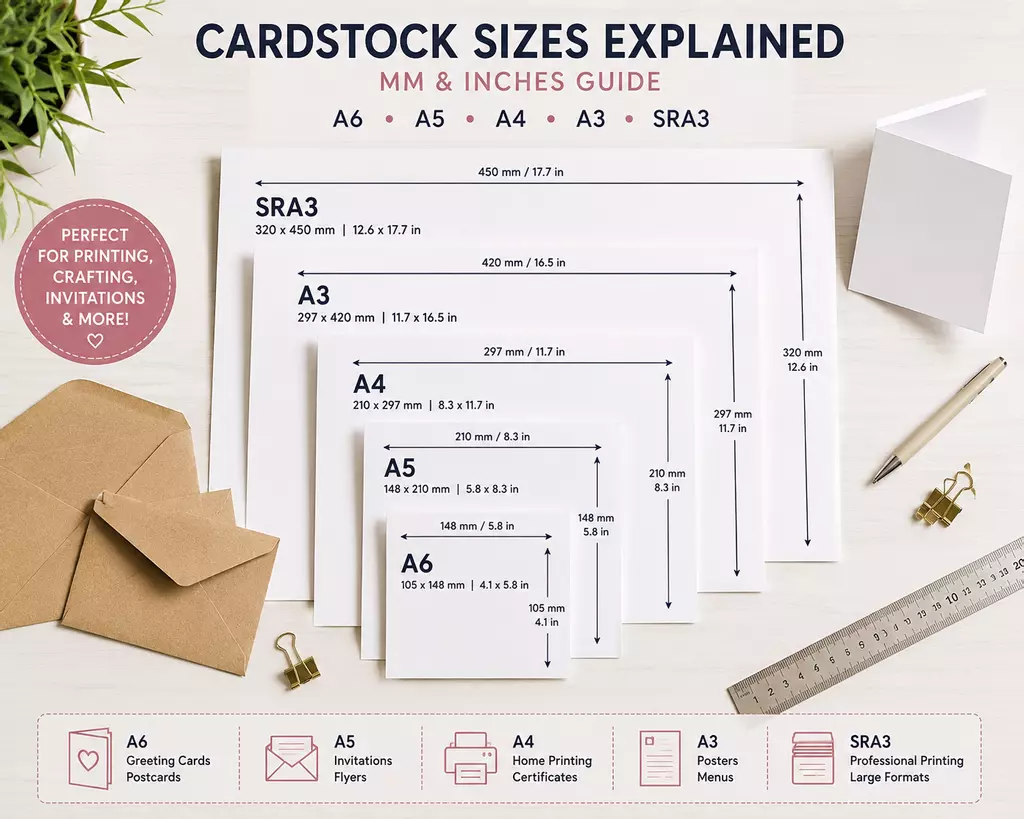
One minute you’re shopping for cardstock, the next you’re staring at measurements wondering whether your invitations will fit in the envelopes you bought three coffees ago.
You’re not alone.
Whether you're printing greeting cards, designing wedding invitations, crafting business flyers, or attempting to convince your home printer to cooperate with 300gsm cardstock, understanding paper and card sizes makes life much easier.
In this guide, we’ll explain the most common cardstock sizes in both millimetres and inches, what they’re typically used for, and how to choose the right size for your project without needing a degree in commercial printing.
| Size | Dimensions (MM) | Dimensions (Inches) | Common Uses |
|---|---|---|---|
| A7 | 74 x 105 mm | 2.9 x 4.1 in | Small invitations, tags |
| A6 | 105 x 148 mm | 4.1 x 5.8 in | Greeting cards, postcards |
| A5 | 148 x 210 mm | 5.8 x 8.3 in | Flyers, folded cards |
| A4 | 210 x 297 mm | 8.3 x 11.7 in | Home printing, posters |
| A3 | 297 x 420 mm | 11.7 x 16.5 in | Large signage, menus |
| SRA3 | 320 x 450 mm | 12.6 x 17.7 in | Professional printing |
The A-size system is designed so that each size is exactly half the size of the one above it.
Which means:
Simple once you know it. Mildly confusing until then.
This sizing system is part of the ISO 216 international standard, which is widely used across the UK and Europe.
One of the reasons it works so well is because the proportions remain consistent when scaling designs up or down. Printers, designers and stationery makers love this. Your printer occasionally does not.
A6 measures:
This is one of the most popular greeting card sizes because it’s compact, easy to post, and works beautifully for invitations, thank you cards and postcards.
If you’re looking for cardstock suitable for A6 projects, our A6 White Craft Card is a popular option for printing, crafting and card making.
One thing that confuses people is seeing products described as:
A5 folds to A6
This simply means the card starts as A5 when flat, then folds in half to create an A6-sized greeting card.
This format is extremely common for:
Our 300gsm A5 Pre-Scored White Card Blanks That Fold to A6 are designed specifically for this purpose, with a pre-creased fold line to make folding cleaner and easier.
Because nobody wants a greeting card fold that looks like it lost a fight with a ruler.
A4 is probably the size most people already know because it’s the standard size used in most home and office printers.
A4 measures:
It’s ideal for:
Our A4 White Craft Card and Paper is available in a range of thicknesses suitable for both professional and creative projects.
SRA3 is where things start sounding slightly more industrial.
SRA3 measures:
Unlike standard A-sizes, SRA3 is an oversized format used mainly in commercial printing.
The extra space allows printers to:
This makes SRA3 particularly useful for:
Our SRA3 White Card is popular with commercial printers and businesses needing larger print stock.
Not all cardstock follows standard A-sizes.
Square cards are especially popular for:
One common size is 148mm square, which measures:
Our 148mm Square 300gsm Pre-Scored Card is designed for square greetings cards and invitations with a professional folded finish.
Square cards often stand out more visually — although they may also attract slightly higher postage costs depending on your postal service. Apparently even envelopes have opinions.
One thing that regularly causes confusion is that the UK and US use different standard paper systems.
| UK / ISO Size | Closest US Equivalent |
|---|---|
| A4 | Letter |
| A3 | Tabloid |
| A5 | Half Letter |
| A6 | Postcard Size |
US Letter size is slightly shorter and wider than A4, which can occasionally create printing alignment issues if the wrong paper settings are selected.
Which is printer language for:
I’m about to ruin your afternoon.
The best cardstock size depends entirely on your project.
A5 folded to A6 is one of the most common and versatile options.
A6 and square cards are both popular choices.
A3 and SRA3 provide more space for larger designs.
A4 remains the easiest and most compatible size for most printers.
SRA3 offers additional space for trimming and professional finishing.
An “A5 folds to A6” card is larger before folding.
Always check envelope sizing before ordering invitations or cards.
Some home printers struggle with heavier cardstock.
Always check your printer specifications before buying thicker paper or card.
Many standard home printers only support up to A4.
Unfortunately, forcing oversized cardstock into a small printer rarely ends well.
A6 measures approximately 4.1 x 5.8 inches.
No. A4 is slightly taller and narrower than US Letter size.
A5 folded to A6 is one of the most commonly used greeting card formats.
SRA3 is an oversized printing sheet used mainly in commercial printing to allow space for trimming and bleed areas.
Many can, but compatibility depends on your printer and the cardstock thickness (gsm).
Choosing the right cardstock size doesn’t need to feel complicated.
Once you understand how A-sizes work and how folded card dimensions relate to flat sheet sizes, picking the right cardstock becomes much easier — and significantly less likely to end in printer-related despair.
Whether you're creating wedding invitations, greeting cards, craft projects or professional print materials, understanding your cardstock sizes helps you get cleaner results, better compatibility, and fewer expensive mistakes.
And that’s always nicer than discovering your envelopes are the wrong size after printing 200 invitations.