
MENU
MENU
Cookie Privacy Preferences
We utilize essential cookies to ensure our website operates effectively and remains secure. Additionally, we'd like to request your permission to use optional cookies. These are intended to enhance your browsing experience by offering personalized content, displaying advertisements that are relevant to you, and helping us to further refine our website.
Choose "Accept all cookies" to agree to the use of both essential and optional cookies. Alternatively, select "Let me see" to customize your preferences.
Privacy Preference Centre
Our website utilizes cookies to enhance your browsing experience and to present you with content tailored to your preferences on this device and browser. Below, you will find detailed information about the function of cookies, enabling you to make informed choices about which cookies you wish to accept. Please note that disabling certain cookies might impact your user experience on our site. It's important to remember that cookie preferences need to be set individually for each device and browser you use. Clearing your browser's cache may also remove your cookie settings. You have the freedom to modify your cookie preferences at any point in the future.
For a comprehensive understanding of our use of cookies, please refer to our complete cookies policy.
These cookies are needed for the website to work and for us to fulfil our contractual obligations. This means they can't be switched off. They enable essential functionality such as security, accessibility and live chat support. They also help us to detect and prevent fraud. You can set your browser to block or alert you about these cookies, but it means some parts of the site won't work.
These cookies allow us to measure and improve the performance of our site. They help us to know how popular pages are, and to see how visitors move around the site. If you don't allow these cookies, we won't know when you've visited our site, and we won't be able to monitor its performance.
These cookies enable us to provide enhanced functionality and personalisation. They may be set by us or by third party providers whose services we've added to our pages. If you don't allow these cookies, some or all of these services may not work properly.
These cookies collect information about your browsing habits to show you personalised adverts. They may be used to build a profile of your interests and show you relevant adverts on other sites. They don't store directly personal information, but are based on uniquely identifying your browser and internet device. If you don't allow these cookies, the adverts you see will be less relevant.
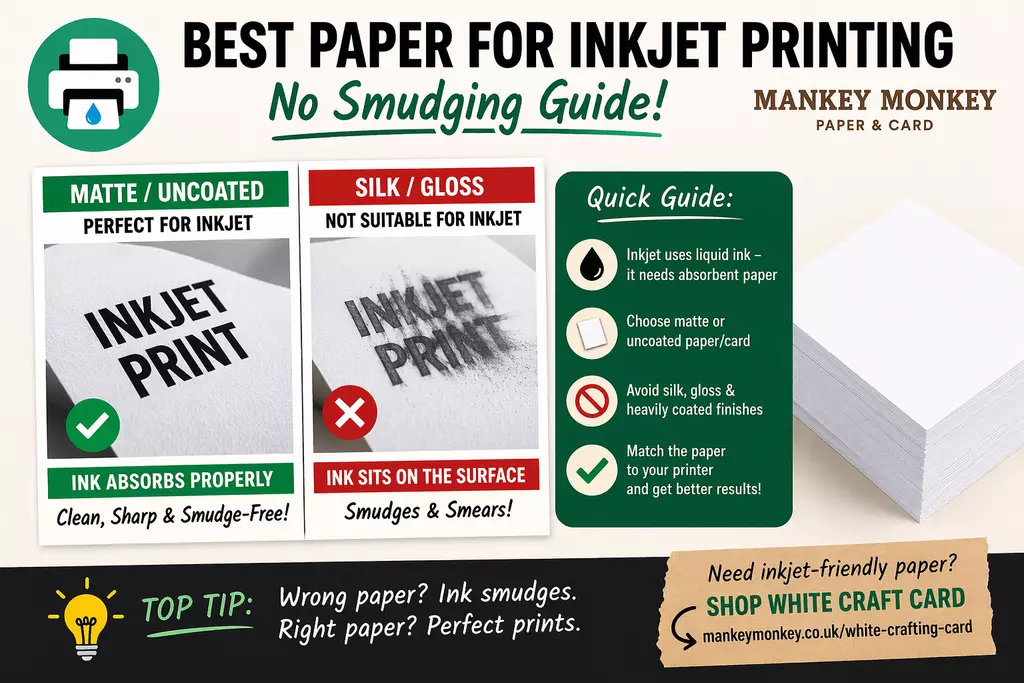
Ever printed something that looked perfect… until the ink started bleeding, smudging, or just refusing to behave?
If you’re using an inkjet printer, the paper you choose makes a massive difference.
Let’s make sure you’re using the right one.
This catches a lot of people out.
Some papers are designed for:
Others are designed to:
If you get the wrong one, things can go downhill fast.
Inkjet printers use liquid ink.
That means the paper needs to absorb the ink. If it doesn’t, the ink just sits on the surface instead of drying properly.
That’s when you get:
Sound familiar? You’re not alone.
For inkjet printing, you’ll usually get the best results with matte or uncoated paper and card.
This type of paper is better at absorbing ink, which means:
If you’re printing at home or using a standard inkjet printer, this is the safe choice.
Shop Inkjet-Friendly White Craft Card & Paper
If you're using an inkjet printer, it’s best to avoid:
These papers are designed for laser and digital printing, not inkjet printers.
If you’ve ever ended up with smudged prints on silk paper, this is usually the reason.
Read our guide: Why Silk Paper Smudges on Inkjet Printers (and How to Avoid It)
Same job, different method, very different paper needs.
If your prints aren’t coming out right, it’s rarely because your printer has suddenly developed a personal issue with you.
Most of the time, it’s just the wrong paper.
Get that right, and your printing life becomes a lot less annoying.
Matte or uncoated paper/card is usually the best choice because it absorbs ink properly and helps prevent smudging.
You can try, but smudging is very likely because silk paper has a coated surface that doesn’t absorb liquid ink well.
Uncoated or matte paper is usually best for avoiding ink smudges on inkjet printers.
That depends on your project and your printer. Standard paper works well for everyday printing, while thicker card is great for craft and presentation use, as long as your printer can handle it.