
MENU
MENU
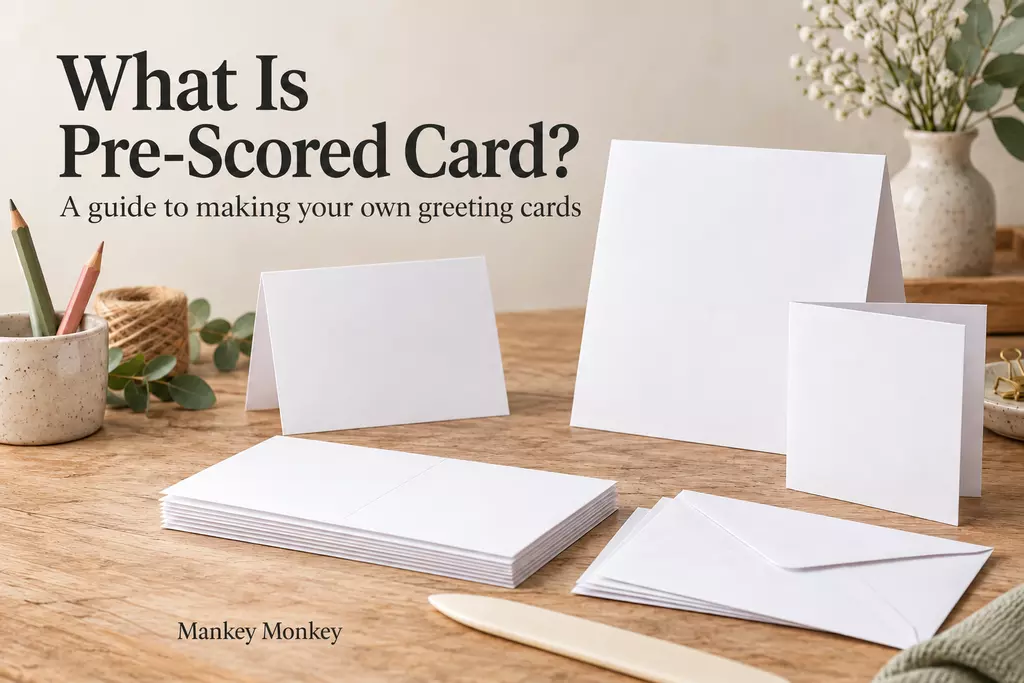
Making your own greeting cards should be about creating something brilliant—not wrestling a sheet of card into submission and hoping the edges meet.
Pre-scored card blanks are blank sheets of card with a fold line already pressed into them. They give you a ready-made base for birthday cards, Christmas cards, wedding invitations and thank-you notes, with less measuring and fewer wonky-fold incidents.
Whether you’re making ten cards for family or building a range to sell, here’s how to choose the right size, card weight and envelope for the job.
Pre-scored card has a line pressed into the card where it needs to fold. The score helps guide the fold, making it easier to create a neat greeting card.
Our pre-scored white card blanks are supplied flat. You can print or decorate them before folding, and store them neatly until you’re ready to start.
Think of the score as a little helping hand. We’ve sorted the folding position; you supply the artistic genius. Or the birthday joke your brother has heard seventeen times.
Starting with a prepared blank saves you cutting sheets to size and measuring every fold yourself. That’s useful for a few handmade cards and particularly handy when you’re making a batch.
Pre-scoring helps you:
Scoring can also help reduce cracking at the fold, although results depend on the card, any printed coverage and how it is folded. A score line helps; it doesn’t grant the card supernatural powers.
Choose your greeting card by its finished, folded size—but use its flat size when setting up a print design.
An A5 sheet folded in half becomes an A6 greeting card. An A4 sheet folded in half becomes an A5 greeting card. The larger size describes the open blank.
Here’s a quick guide to the options featured below:
| Card blank | Flat size | Finished folded size | Weight |
|---|---|---|---|
| A6 folds to A7 | 105 × 148mm | 74 × 105mm | 250gsm |
| A5 folds to A6 | 148 × 210mm | 105 × 148mm | 300gsm |
| A5 folds to A6, with envelopes | 148 × 210mm | 105 × 148mm | 300gsm |
| A4 folds to A5 | 210 × 297mm | 148 × 210mm | 350gsm |
| 148mm square | 296 × 148mm | 148 × 148mm | 300gsm |
Always check the product details before ordering.
This is the bit worth double-checking before you design fifty cards. Discovering you’ve laid everything out at twice the intended size is an excellent way to invent new swear words.
A7 is a compact format for short messages, little thank-you cards and small invitations. It suits designs that don’t need much space: a simple illustration, a few words or a stamped motif.
Our 250gsm A6 pre-scored white card blanks fold to A7 and are supplied without envelopes.
Small card. Plenty of personality. Much like a monkey with a megaphone.
A6 is a versatile choice for birthday cards, Christmas cards and personalised greetings. It gives you room for an illustration or photograph on the front and a message inside, without needing an essay to fill the space.
Choose our 300gsm A5 pre-scored white card blanks for an A6 finished card.
If you want envelopes included, our 300gsm A6 card blanks with envelopes pair the same flat A5 format with white C6 envelopes.
A5 greeting cards offer more space for larger artwork, photographs, bold lettering or a message signed by several people.
Our 350gsm A4 pre-scored white card blanks fold to A5 and have a smooth white matte finish.
A useful choice when “Happy Birthday, Dave” needs to share space with signatures from half the office.
A square format works well for centred illustrations, wreath designs and balanced layouts.
Our 148mm square 300gsm pre-scored card blanks arrive flat at 296 × 148mm and fold to 148 × 148mm. Envelopes are not included.
Remember to choose an envelope that accommodates the finished square card, with room for any decorations.
GSM means grams per square metre: it describes the card’s weight, rather than its exact thickness. Two different cards with the same GSM can feel different.
For the white card blanks featured here:
The right choice also depends on your design, decorations and printing method. Heavier isn’t automatically better if your printer refuses to feed it.
Your printer did not sign up for competitive weightlifting.
You can print on suitable pre-scored card, provided your printer supports the card’s weight, thickness and flat sheet size.
For these white matte blanks, check your individual inkjet, laser or digital printer specifications before buying. Pre-scored does not mean compatible with every printer.
Before starting a batch:
Print while the blank is flat and let the print dry or settle before folding. If you want printing on both sides, check whether your printer supports double-sided printing at that card weight.
For handmade designs, you can skip the printer and use pens, stamps or layered decorations. Test your chosen materials first, especially wet inks and adhesives.
Work on a clean, flat surface. Gently fold along the existing score, line up the edges and smooth the fold with a clean bone folder or similar suitable tool.
Avoid forcing the card or repeatedly bending it backwards and forwards. If you’ve printed across the fold, test a finished sample to check the result.
There’s no prize for folding at Olympic speed. A little care now saves a wonky card later.
The blanks featured in this guide are supplied flat, with the fold position already scored. You fold them when you’re ready.
Not necessarily. An A5 flat blank folded in half produces an A6 greeting card. Check whether a listing describes the flat or finished size.
Check the individual listing. We offer both card-only products and an A5-to-A6 300gsm card-and-envelope option, which includes white C6 envelopes.
Only if your printer supports that card weight, thickness and sheet size. Check its specifications and test a small pack first.
The fold position is already scored, so you don’t need a scoring board to add that fold line. A bone folder can help smooth the finished crease.
Yes. Choose a size and weight that suit your designs, then test your printing or decorating process before making a batch for sale.
Start with the finished size you want, choose a card weight that suits your project and check your printer if you’ll be printing.
Whether you’re making small thank-you notes, everyday A6 greetings, larger A5 cards or a square collection, the right pre-scored blank makes preparation easier.
Pick your blanks from the options above, bring your ideas and let the Monkey help with the foundations. Glitter management remains firmly your department.